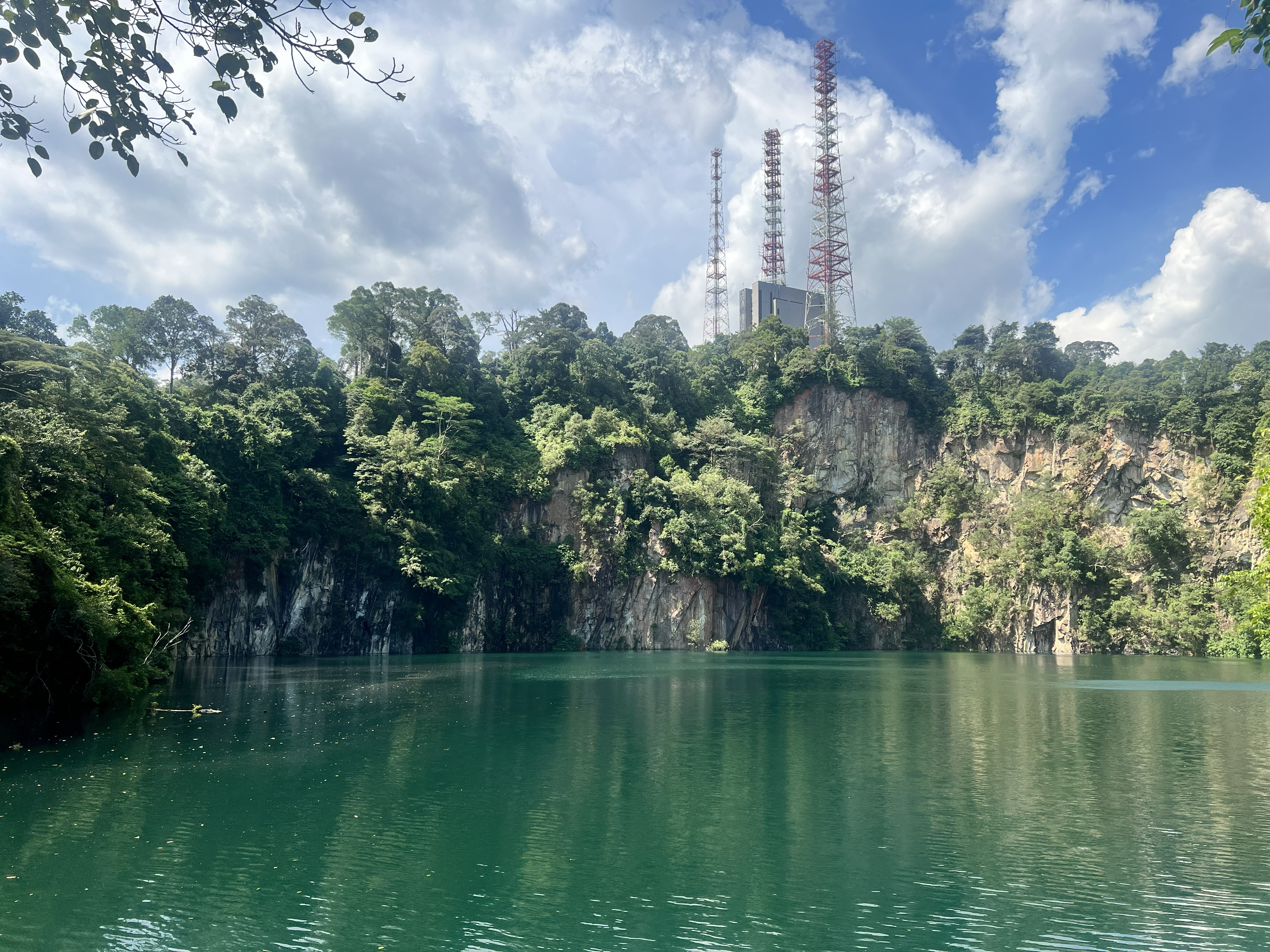
You feel the desire to appreciate the view that lies ahead of you. Looking around, you find a damp wooden bench in a shaded patch of the pier you stand on. Even from here, sitting down, the quarry looks as stunning as ever. What do you do?
Peer into the waters below?
Take in the sights and sounds?
You think a bit about the history of the place you're in. You open a history book of the quarry.
      __...--~~~~~-._   _.-~~~~~--...__
    //               `V'               \\
   //                 |                 \\
  //__...--~~~~~~-._  |  _.-~~~~~~--...__\\
 //__.....----~~~~._\ | /_.~~~~----.....__\\
====================\\|//====================
                dwb `---`
One of the major threats to the Bukit Timah reserve was granite quarrying – the discussion for which had started as early as 1902 in the face of increasing demand for granite, used for constructing roads and other infrastructure.
In the late 1940s to 1950, public disagreements arose regarding the presence of quarries in the Bukit Timah forest, and their threat to the nature reserve as they encroached on the area. Again, Holttum was central in the discussion and advocated for protection of the reserve against the exploitation of natural resources.
The government responded by appointing a committee to study the situation. The final report released in 1951 recommended the gradual closure of the quarries in the immediate vicinity of the nature reserve; until then, restrictions would be imposed on quarry operators to safeguard the area. Significantly, the report led to the enactment of the Nature Reserves Act of 1951, which accorded legislative protection to nature reserves – a milestone in the history of nature conservation in Singapore.
Quarrying at Bukit Timah, however, continued until the 1990s. The now-disused Hindhede Quarry, located just outside the southwestern end of the Bukit Timah Nature Reserve, had existed as early as the 1930s and only closed in 1990. It is presently part of the Hindhede Nature Park, which opened on 17 August 2001.